FREDA FAQs
Your questions. Clear answers.
Meet the Federal Recovery Executive Digital Agent: purpose, capabilities, coverage, access, and human accountability.
What is FREDA designed to do?
FREDA helps disaster recovery teams research requirements, analyze documents, identify missing information, coordinate workflows, monitor policy changes, prepare recommendations, strengthen administrative records, and turn complex program information into actionable intelligence.
FREDA is designed to support the full disaster recovery lifecycle - from program design and applicant intake through eligibility, environmental review, construction, procurement, finance, monitoring, closeout, and executive reporting.
Who is FREDA ideally suited for?
FREDA is designed for state agencies, counties, municipalities, tribal governments, CDBG-DR grantees and subrecipients, emergency management organizations, housing programs, program managers, grant administrators, construction managers, compliance and finance teams, prime contractors, consultants, and executive leadership.
Disaster survivors can also benefit from plain-language explanations, help organizing questions and document checklists, and research into relevant assistance resources. FREDA does not determine eligibility, award benefits, or replace a case manager.
What is the business value of FREDA?
FREDA is designed to reduce repetitive administrative work, accelerate research and document review, identify missing information earlier, improve consistency, strengthen monitoring readiness, improve executive visibility, and reduce avoidable rework and compliance risk.
For contractors and consultants, it can also help preserve institutional knowledge, standardize quality control, improve staff productivity, and support growth without requiring administrative staffing to increase at the same rate.
How is FREDA different from a general AI chatbot?
A general AI assistant primarily answers questions. FREDA is designed around disaster recovery operations.
It combines specialized disaster recovery knowledge, regulatory intelligence, document analysis, workflow coordination, compliance support, program-specific knowledge, executive intelligence, and human approval controls. The goal is not merely to produce an answer, but to explain how the answer affects the program, the documentation required, the risk involved, and the next operational step.
What types of disaster recovery programs can FREDA support?
FREDA can be configured to support CDBG-DR, CDBG-MIT, FEMA disaster recovery programs, FEMA Public Assistance, housing disaster recovery, infrastructure disaster recovery, mitigation, federally funded construction, grant management, and other federal, state, and locally administered disaster recovery programs.
Does FREDA cover all 50 states and U.S. territories?
FREDA is designed to support all 50 states and U.S. territories. The current desktop library includes all 50 states, Puerto Rico, the U.S. Virgin Islands, and Guam; other territory and program libraries are configured during implementation. Federal authority, jurisdiction-specific program rules, contract requirements, and advisory practices remain distinct. Source coverage and currency are reviewed for each implementation.
Can FREDA help with document and applicant file review?
Yes. FREDA can assist with file completeness, document comparison, summaries, checklists, issue identification, review notes, quality control, and monitoring readiness. Final determinations remain with authorized personnel when decisions affect eligibility, benefits, payments, procurement, enforcement, or other material actions.
Can FREDA monitor regulatory and policy changes?
Yes. FREDA's intelligence capabilities are designed to monitor developments involving HUD, FEMA, the Federal Register, CDBG-DR, CDBG-MIT, OMB guidance, 2 CFR Part 200, waivers and alternative requirements, disaster declarations, action plans, and relevant disaster recovery procurements.
The goal is not simply to identify a change, but to explain what changed, who may be affected, what program processes may need review, and what should be watched next.
How does FREDA go beyond traditional disaster recovery services?
FREDA goes beyond a single-purpose consulting service, dashboard, document repository, newsletter, or case-management tool by bringing multiple capabilities together in one disaster recovery-focused environment.
It can connect policy + program knowledge + documents + workflows + compliance + construction + funding + procurement + executive intelligence while working alongside existing staff, consultants, and systems.
Can FREDA cite the governing authority behind a recommendation?
Yes. At your request, FREDA can provide citations to applicable governing authorities supporting a recommendation, such as statutes, regulations, Federal Register notices, HUD or FEMA guidance, and relevant program policies, where those sources are available in the configured library or research results.
Ask FREDA to identify the source, section, date, and link when available, explain how it relates to your program and jurisdiction, and distinguish binding requirements from guidance or suggested practices. Citations and their applicability should be checked against the current official source; if supporting authority cannot be located, the recommendation needs further review.
How is FREDA information vetted for accuracy and relevance?
FREDA is designed to support source-based research, but an AI-generated answer is not itself an authoritative program determination. Before using an answer, check the cited official document, its publication and effective dates, the applicable funding source and jurisdiction, and any amendments or waivers.
For a scoped implementation, the team and customer agree which source libraries to use, who reviews outputs, and how updates and gaps will be handled. Review frequency, source coverage, and approval controls must be confirmed for that deployment; this website does not claim that every answer is independently verified or that every source is continuously current.
If a source is missing, outdated, or conflicts with program guidance, pause and ask the responsible program official or subject-matter expert to resolve it. Final eligibility, funding, procurement, and compliance decisions remain with authorized people.
Does FREDA replace staff or government decision-makers?
No. FREDA is designed as human-supervised agentic AI.
FREDA prepares, verifies, coordinates, explains, and recommends. Authorized officials review, approve, and remain accountable for material decisions involving eligibility, awards, payments, appeals, procurement, enforcement, policy authority, and similar government actions.
Is FREDA a government agency?
No. FREDA is a Gagner Services Group LLC initiative, not a government agency or an official HUD or FEMA service.
Can FREDA be customized for our organization?
Yes. FREDA can be configured around an organization's policies, procedures, approval authorities, forms, templates, workflows, organizational structure, funding sources, terminology, construction processes, financial controls, monitoring protocols, reporting requirements, and technology environment.
The objective is for FREDA to adapt to the disaster recovery program rather than force the disaster recovery program into a generic AI workflow.
Can FREDA integrate with our existing systems?
FREDA is designed to be integrative. Depending on the implementation, it can work alongside grant-management systems, case-management platforms, document repositories, construction systems, financial systems, procurement systems, CRMs, reporting environments, data warehouses, APIs, and structured data feeds.
Integration requirements are evaluated during implementation because each customer's technology and security environment is different.
How can we access FREDA?
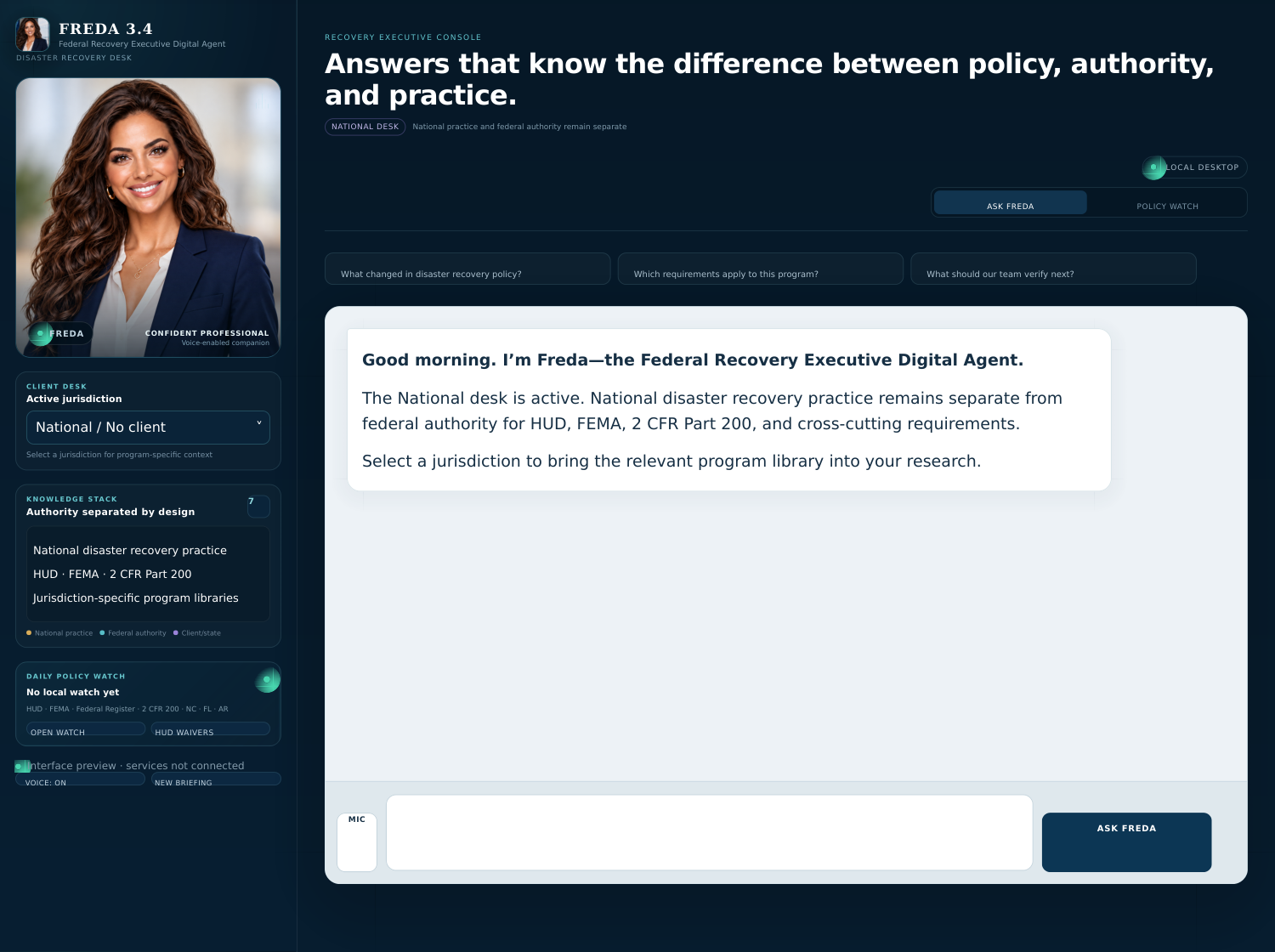
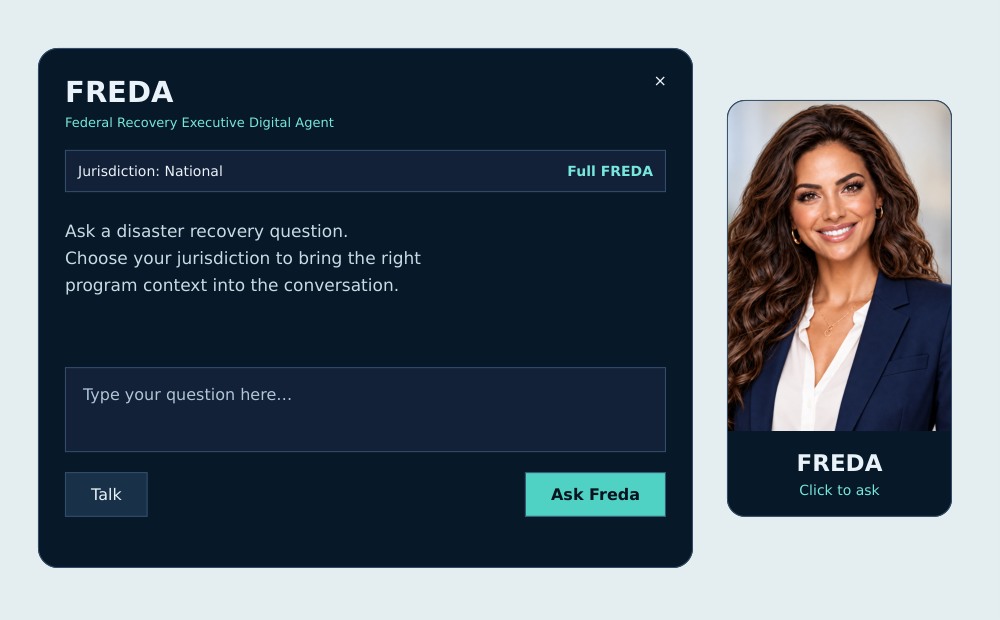
FREDA is designed for flexible deployment and can be configured for access online through a secure web environment, through an app/mobile experience, or through a desktop application.
This allows organizations to choose the deployment model that best fits their workforce, security posture, IT environment, and field operations.
The mobile experience is an installable web app connected to a configured hosted FREDA instance. Desktop options include the Windows digital companion and full research workspace. Access and features are confirmed during onboarding; this website is a product preview, not the live FREDA service.
Do we have to deploy FREDA across the whole organization at once?
No. FREDA supports phased adoption. An organization can begin with advisory and research functions, expand to assisted workflows, introduce supervised automation for approved routine activities, and ultimately coordinate specialized agents and systems across the disaster recovery lifecycle.
A focused pilot is often the best way to establish measurable value before broader deployment.
Why should an organization consider FREDA now?
Disaster recovery programs are becoming more data-intensive, compliance-heavy, and operationally complex while agencies and contractors continue to face staffing, schedule, documentation, and coordination pressures.
FREDA provides a path to adopt AI specifically for disaster recovery while preserving human accountability. It is designed to help organizations move from fragmented information and repetitive administration toward coordinated, evidence-based disaster recovery operations.
What does FREDA stand for?
FREDA stands for Federal Recovery Executive Digital Agent.
FREDA is an AI-powered disaster recovery intelligence and program administration platform designed to help disaster recovery organizations manage complex programs, changing requirements, documentation, workflows, compliance, and executive decision support.
Can I try FREDA before committing?
Request a demonstration to discuss a focused pilot. Scope, pricing, access, and evaluation goals are agreed before work begins.